How Much Did Inflation Steal From Your Gain?
You could be paying taxes on gains that only exist because your money lost value. TaxAlign AI shows your nominal gain, your real inflation-adjusted gain, and the phantom gain in between — free.

You may be paying tax on profit you didn’t really earn.
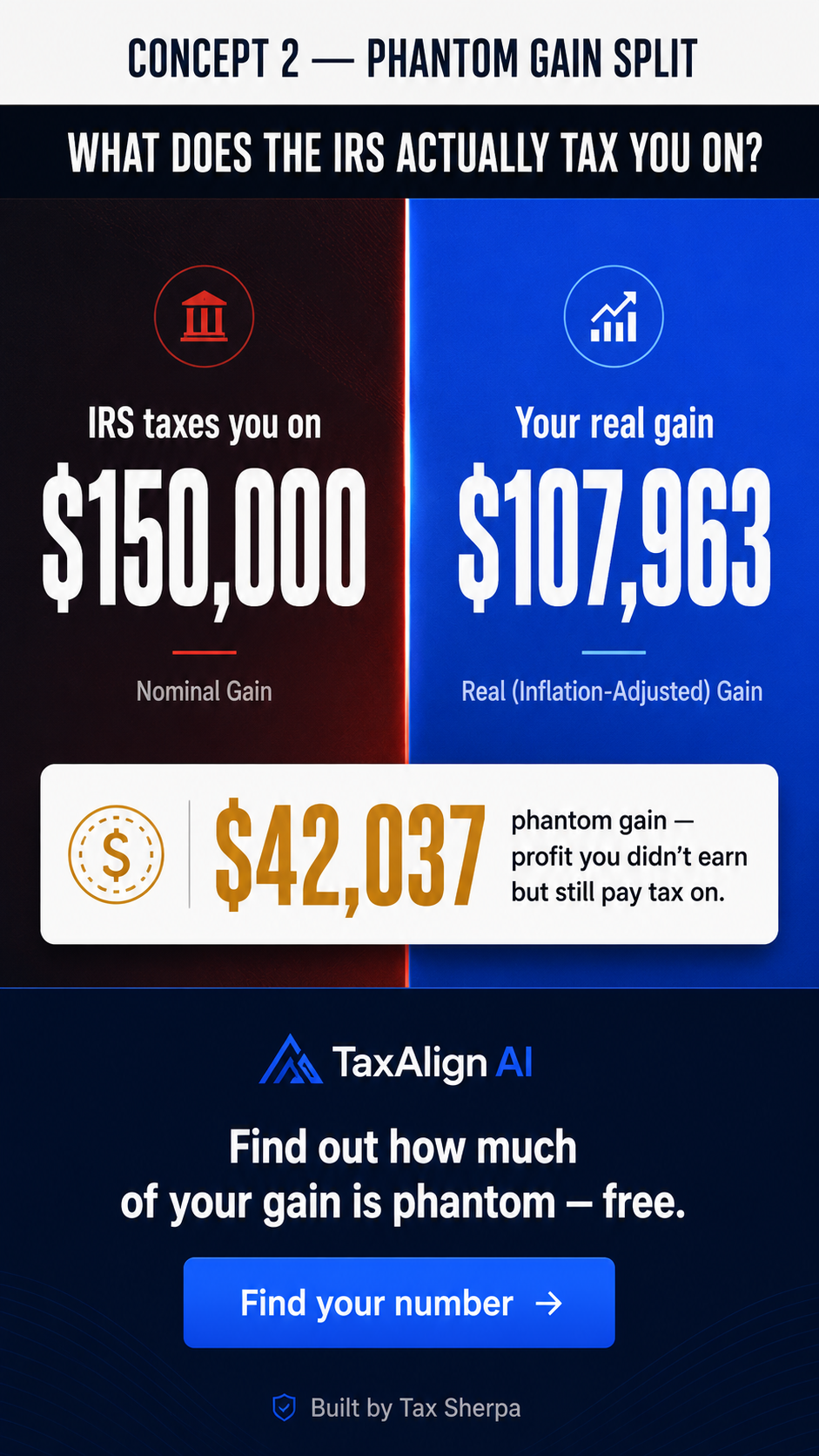
Say you bought an asset years ago for $100,000 and sell it today for $250,000. On paper, that looks like a $150,000 gain. But after adjusting your original cost basis for inflation, your real economic gain may be much lower.
What the IRS generally sees before inflation is considered.
What you earned after adjusting your original cost for inflation.
The inflation portion of your gain that may still be taxed.
Enter a few numbers. Get your real gain.
TaxAlign AI estimates your inflation-adjusted capital gain using the asset details you provide, then shows the difference between your paper gain and your real gain.
This is what you get — free.
TaxAlign AI gives you a personalized snapshot of your gain, your phantom gain, and tax-smart strategies to consider before you sell.

Inflation-Adjusted Gain Report
See your nominal gain compared with your real, inflation-adjusted gain.
Phantom Gain Estimate
Find the portion of your apparent gain that may be attributable to inflation.
Estimated Tax Impact
Get a clearer view of how your gain may be taxed under your assumptions.
Capital Gains Strategy Pack
Review possible planning options to discuss with your tax advisor.
Works for more than one kind of long-term asset.
Use TaxAlign AI to estimate inflation-adjusted gains for real estate, stocks, funds, business assets, and other long-held investments.
Real Estate
Homes, rental properties, land, and investment property.
Stocks & Funds
Public companies, ETFs, mutual funds, and taxable brokerage holdings.
Business Assets
Private business interests, equipment, inventory, and intellectual property.
You don’t have to wait for tax law to change.
Even if tax rules stay exactly where they are, there may still be planning moves available before you sell. Your TaxAlign AI report helps you understand common options and have a more informed conversation with your tax advisor.
TaxAlign AI is educational and does not provide individualized tax, legal, investment, or accounting advice. Strategies depend on your facts and current law.
1031 Exchange
Potentially defer gain by rolling proceeds from one qualifying real estate investment into another.
Tax-Loss Harvesting
Use realized investment losses to offset realized gains where appropriate.
Installment Sale
Spread gain recognition across multiple tax years instead of taking it all at once.
Section 121 Exclusion
For qualifying primary residence sales, part of the gain may be excludable.
Find out how much of your gain is phantom.
Run your free TaxAlign AI analysis and see your nominal gain, real gain, phantom gain, and capital gains strategy pack.